
January 3rd, 2026.
Book launch of Scent of Hypnosis with Julia Geerlings.

2025.
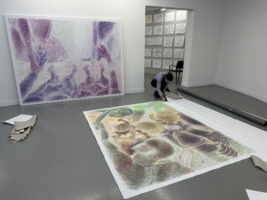
Àngels Miralda, curator and author of Scent of Hypnosis. During installation.
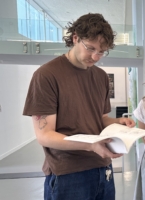
Noa Zuidervaart in Drawing Centre Diepenheim during presentation concept of Scent of Hypnosis.
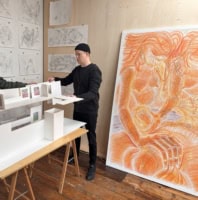
2025
Travis Jeppesen, author of Scent of Hypnosis. With the scale model of Drawing Centre Diepenheim in the studio.
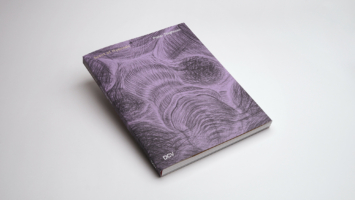
Scent of Hypnosis
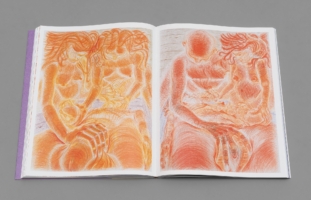
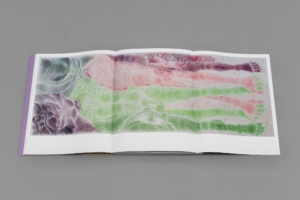
Scent of Hypnosis
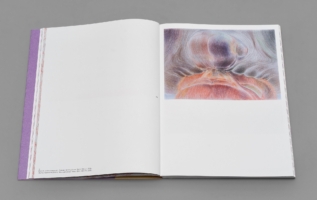
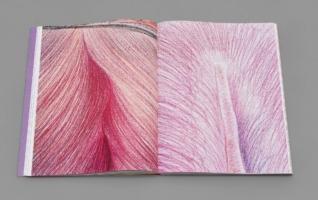
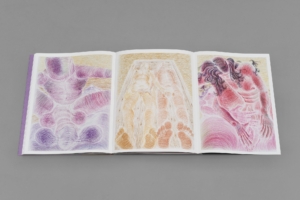
2025.
Installation Scent of Hypnosis at Drawing Centre Diepenheim.

2025.
Àngels Miralda and Travis Jeppesen. Antwerp.
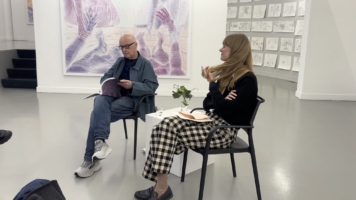
January 3rd, 2026.
Julia Geerlings and Pieter Slagboom in conversation.
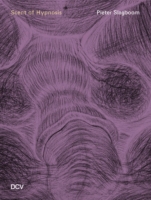
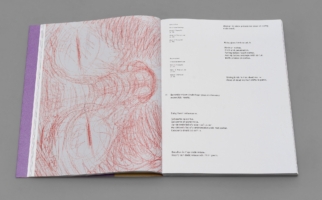
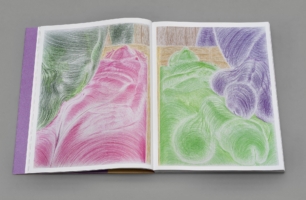
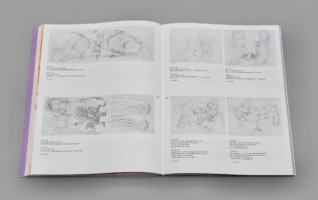
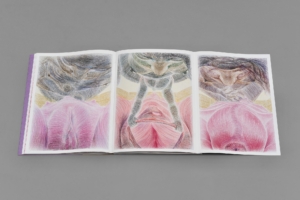
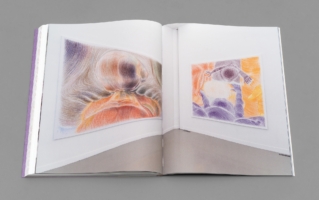
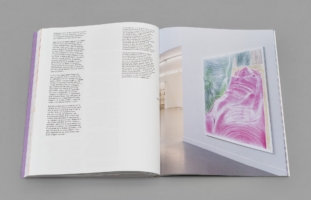
Scent of Hypnosis cover.
Scent of Hypnosis.
Book published by DCV books on the occasion of the project for Drawing Centre Diepenheim in 2025.
Exhibition curated by Àngels Miralda.
Authors:
Estelle Hoy
Travis Jeppesen
Àngels Miralda
Noa Zuidervaart
By Àngels Miralda
Sensualities Beyond the Living
Pieter Slagboom’s work insists on birth, death, and eternal return as a web of unsolvable questions. These concerns reach beyond the present, speaking to something that has long lurked in human nature despite centuries of attempted erasure. The compositions in Slagboom’s recent works express human physicality through active sexual organs. Bringing these to the forefront, he boldly confronts the contemporary oblivion of the primal self. The artist describes his subject matter using the terms “radical biology” and “personal anthropology”; both of these function within non-linear time and the hidden molecular archives of identity. Restless within the confines of contemporary society, Slagboom’s images traverse a haunting geological and evolutionary time that spans generations and the production of a world to come.
Two cocks rub together, one of a dead man, the other alive. Gargantuan feet press onto the smashed faces of sleeping people, squeezed into wooden floorboards. Slagboom’s figures take on uncanny postures as gray matter somewhere between the living and the dead. In his imaginative world, sexual play is a way of pushing life back into the corpse, of resuscitating the deceased, and of working towards an in-between of organic substance. This subject, or rather liminal state, is familiar to Dutch audiences whose historic masters shared comparable concerns during the 17th century, with the genre of stilleven, the still life. The French term nature morte perhaps points more explicitly towards the idea that the botanical and vegetal substances depicted in these canvases were often metaphors for the unpaintable. These served, in many instances, as memento mori—or reminders that everything comes to an end. Painters such as Pieter Claesz immortalized this genre with the dirty messiness of banquet remnants. The eaten-up platters and upended chalices were rendered with a controlled painterly perfection that contrasted with the gluttony and impermanence of the depicted objects, which were often in visible states of decay. But despite their signs of vitality, these ensembles actively omitted the human body, leaving only gestures of its previous acts, only nods toward ingestion and the timeline of decay that the human shares with flesh and fruit.
Slagboom, though, is freed from gesturing or metaphor. His surfaces are replete with the fruits of human genitalia. Composed in a full and overlapped manner, they are hoisted on platforms that encapsulate copulation within the confines of coffins or wooden floors. Like the feasts that lay dead and decaying after animating our living bodies with energy, Slagboom searches for the temporality of death and life through sexual acts. The body reaches the state of a ripe fruit, brimming with both seeds and putrefaction, neither dead nor alive, decaying and full of energetic potential.
The works presented in Scent of Hypnosis at the Drawing Center Diepenheim have been developed over a long trajectory of life and work. Drawing established itself as the base of all of Slagboom’s work at a later stage in his practice. His approach carries through many of the ideas on color and space that existed in his earliest spatial works. His older drawings contain references to his personal life as a parent, and to the configuration of having children and working as an artist in a society that enforces ceaseless demands. This theme slowly progressed towards an abstract reflection on identity and physicality beyond commonly explored tropes. His first major solo exhibition of large-scale drawings took place in 2019 at the Vleeshal in Middelburg, curated by Julia Geerlings. There, the works were hung from the ceiling, weaving space and scale into Slagboom’s recognizable themes of sex and death. The subject of birth began to filter through his imagery in 2020 at a solo presentation at Bridget Donahue in New York. In Diepenheim, this subject has been expanded into expressions of infantile consciousness, free from societal conditioning, fresh from (or literally exiting) the vaginal canal.
The works in Diepenheim contain some of the largest canvases yet made by Slagboom. The work is physical in nature; building the colored pencil lines up across the linen surface requires pressure and movement—the tools are dragged back and forth across the studio with physical steps. Each drawing represents a months-long process of mark-making, repetition, and endurance, in which the artist unravels both physical and mental processes. One room in the exhibition contains a codex of drawings where Slagboom’s ideas materialize on paper. Whatever the scale, drawing is a process for mentally reworking configurations of body and space.
Breasts, phalli, fingers, and mouths populate canvases devoid of space in which bairns push through into the light. Pressed against their mothers and against others, their neonate bodies are flung into sexual encounters with the living and the dead. After the traumatic passage from the womb, the infant takes its first breaths directly into the funereal corpse of deceased members. Slagboom’s new works take a turn into the psyche of the newborn. In these drawings, the infant’s humanity exists in the lack of a so-called innocence that is typically ascribed to children by the adult world—Slagboom reminds the viewer that the body always carries genitalia, love, violence, and desire, all at once, at every stage of life. The meetings between new and dead flesh visually embody the experiments of early 20th-century psychoanalysts, who considered the missing connection between the mind and the genitalia a primary aspect of their investigations. Inspired by advancements in evolutionary biology, practitioners such as Sigmund Freud, Jacques Lacan, and Sandor Ferenczi changed our understanding of identity into one that recognized the importance of our sexual organs and life events in the conditioning of the human being in terms of identity, behavior, and potential.
Swimming through Slagboom’s canvases is the theory of regression—a concept in psychology in which the psyche returns to an earlier stage of development during periods of stress. Hungarian psychoanalyst Ferenczi outlined the significance of regressive tendencies in physical processes of desire in his study Thalassa: A Theory of Genitality (1938). There, he outlines the concepts of infantile erotism and the sexual drive as consequences of the trauma of birth that is never overcome throughout the developed stages of life. In Slagboom’s figures, infant bodies emerge from the womb already in possession of their own agency. They grab and hold, participating in sexual menageries with the dead and the living, enacting an infant erotism in which “thumb-sucking, […] looking and being looked at, are capable of yielding complete satisfaction.” Sexuality in Slagboom’s work can be understood as a kind of “infant sexuality” in which gender does not yet exist, in which sexual orientation is irrelevant, and in which touch and proximity yield total satisfaction regardless of social conditioning and genital designation, as if the adult figures still inhabited a pre-gendered foetal state. With the development of the sexual organs, intercourse serves as a return to the womb-state of being, termed by Ferenczi as a “transitory regression.”
The principle of physical regression has played a part in popular fiction, such as in JG Ballard’s The Drowned World (1962). This novel imagines a scenario in which regression is not only a psychological process but a physical one, in which the human body could salvage muted archival DNA to produce gills for underwater breathing. Slagboom refers to some of the corpses he depicts as his “alter ego,” which suggests that we carry multiple identities and beings within us, saved away in our complex coded biological physicality. Our DNA is a rich archive that contains parts of all of our predecessors, telling an ancient story of evolution that has been passed down to us in the form of a body—that powerful machine designed to persist at being alive, whether through the literal act of reproduction or through societal contributions that sustain life.
Slagboom’s work is social by nature—no figure stands alone either in life or in death. Crowds come together with sex organs not only as a source of reproduction but to form a social–sexual conglomerate society. If Ferenczi’s womb is a compact copy of a primordial ocean, and a representation not only of our own birth but of a young planet from which we all descend, the compression of space in Slagboom’s drawings illustrates the feeling of the amniotic surroundings that magnetically pull the social body into a singular mass. The canvas, full with bodies and organs, facilitates the primordial state of touching and being touched on all sides by a deep-sea fluid, by an endless ocean of contact that grounds our bodies and sexualities into telluric matter.
Enlightenment rationality created an artificial mind/body split that has become central to the Western concept of the human. Slagboom rips this logic asunder, fiercely opposing any polarity of identity through his compositions. Every notion of the Western self, including distorted and political hypersexualizations, are reformulated into a holistic intergenerational whole. This whole is neither good nor evil, neither innocent nor violent, but is a full acceptance of coexisting selves. All-encompassing flesh becomes a landscape of body and radical sensuality, formulated through a decentralized understanding of the living, the infant, and society. The soul is not expressed through eyes, expression, or the proximity of the head, but through a horizontal and enfleshed social being that invokes our most primal and ancestral selves. Evading categorizations of gender, sexual orientation, or any caliber of societal correctness, Slagboom’s “radical biology” posits our future as the expansion of these boundaries into an unknown. The works in Scent of Hypnosis are a spiritual reconnection and a tender agency—a radical expression of each of our biological eternities.
Publisher: Dr. Cantz’sche Verlagsgesellschaft, Berlin.
Graphic design: Dongyoung Lee.
Publication date: November 11, 2025.
isbn: 978 – 3 – 96912 – 250 – 1
Financial contributors: Mondriaan Fund. Jaap Harten Fund.
Photo’s of the book: Gunnar Meier